
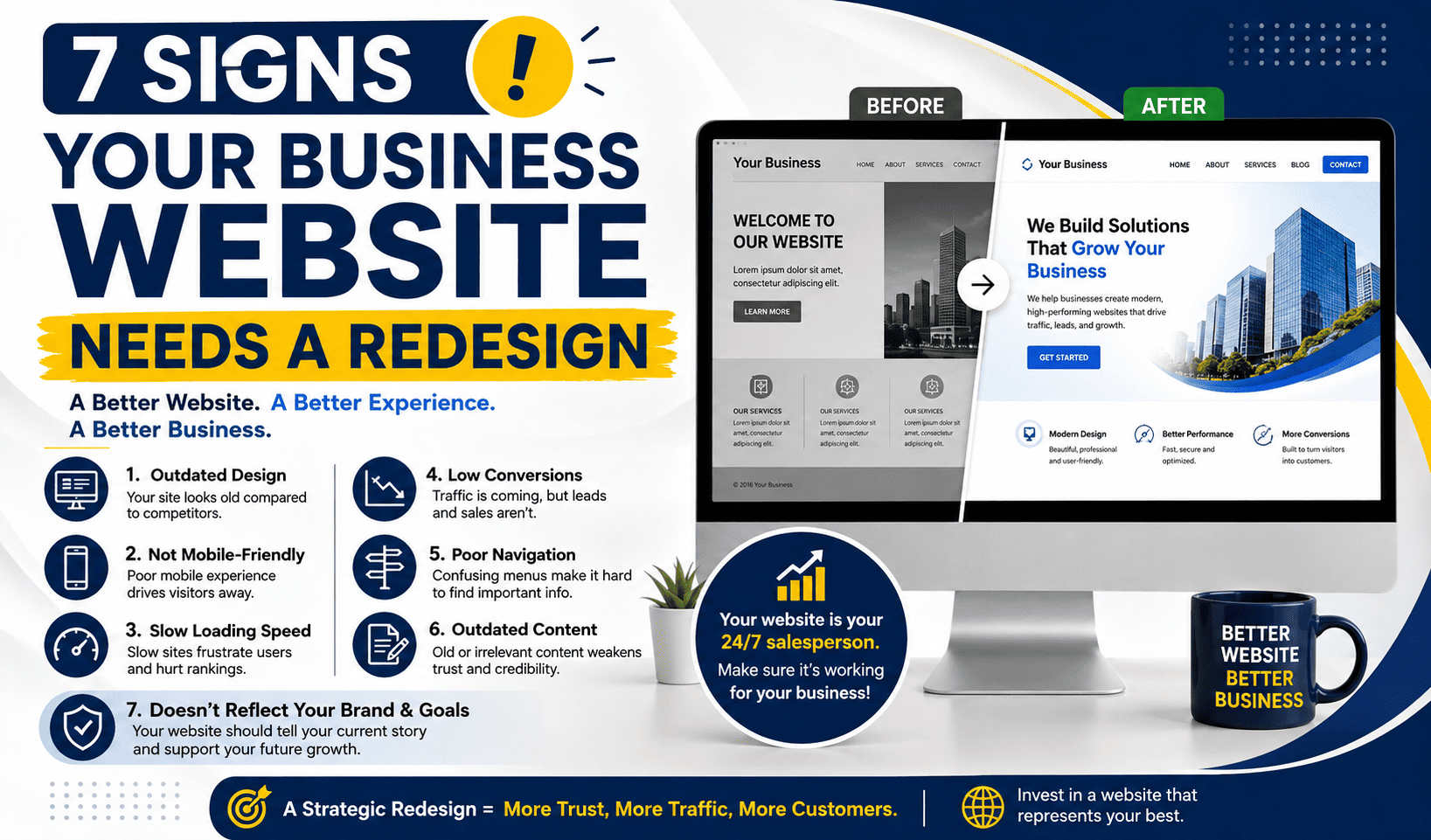
Your business website probably needs a redesign if it looks outdated, performs poorly on mobile devices, loads slowly, is difficult to navigate, generates little or no leads, has weak or outdated content, lacks trust signals, or no longer reflects your brand and business goals. A modern website redesign should improve user experience, speed, accessibility, SEO, conversions, credibility, and the overall customer journey rather than simply changing the colors or layout.
Introduction
Your website is often the first interaction a potential customer has with your business. In the United States, consumers are accustomed to fast, professional, mobile-friendly digital experiences. If your website feels outdated, confusing, slow, or difficult to use, visitors may leave before they ever contact your company. In many cases, the problem is not that your business is offering the wrong product or service. The problem is that your website is failing to communicate its value effectively.
A website redesign is more than giving your homepage a new visual appearance. A successful redesign evaluates the site’s structure, content, user experience, technical performance, search engine visibility, conversion paths, security, and branding. Google also emphasizes the importance of helpful, people-first content and a strong overall page experience rather than optimizing for search engines alone.
If your website was built several years ago and has received little strategic attention since then, it may be time for a serious evaluation. Here are seven important signs that your business website needs a redesign.
1. Your Website Looks Outdated Compared With Your Competitors
One of the clearest signs your business website needs a redesign is an outdated visual appearance. Design trends, user expectations, typography, navigation patterns, mobile layouts, and interactive experiences have changed significantly over the years. A website that looked professional in 2018 may appear old-fashioned or unreliable to today’s visitors.
Potential customers often make quick judgments about a company based on its website. If your pages contain cluttered layouts, tiny text, outdated graphics, inconsistent fonts, excessive animations, stock imagery, or an old-fashioned navigation structure, visitors may question whether your business is equally outdated in other areas.
This does not mean every website needs a trendy design. A professional website should prioritize clarity and usability over visual gimmicks. Your design should communicate what your company does, who it serves, why customers should trust you, and what visitors should do next.
A redesign is particularly important when your website no longer reflects your current brand. If your logo, services, target audience, pricing model, company positioning, or visual identity has changed, your website should change with it.
2. Your Website Is Difficult to Use on Mobile Devices
Another major warning sign is poor mobile usability. Many potential customers discover businesses through smartphones, whether they are searching Google, clicking social media links, reading reviews, or visiting a company’s website after seeing an advertisement.
A website that looks acceptable on a desktop computer can be frustrating on a smartphone. Visitors may have to zoom in to read text, horizontally scroll to view content, tap tiny buttons, deal with overlapping elements, or wait for large images to load.
Google continues to emphasize providing a good page experience across devices. Its guidance also notes that mobile usability remains important for users even though the standalone Mobile Usability report in Search Console was retired.
Your website should automatically adapt to different screen sizes, with readable typography, appropriately sized buttons, intuitive menus, responsive images, and forms that are easy to complete on a phone. If your mobile experience feels like a smaller version of your desktop website rather than a thoughtfully designed mobile experience, a redesign may be necessary.
3. Your Website Loads Slowly
Website speed is another strong indication that your site may need modernization. Visitors generally expect websites to respond quickly. If your homepage takes too long to load, images appear slowly, buttons lag, or pages become unresponsive, users may abandon the site before seeing your offer.
Slow performance can result from oversized images, excessive plugins, poorly optimized JavaScript, outdated themes, inefficient hosting, unnecessary third-party scripts, database problems, or poorly implemented tracking and marketing tools.
Performance should not be treated as a separate technical issue from website design. A visually impressive website that takes several seconds to become usable can still create a poor customer experience.
Google recommends paying attention to overall page experience and Core Web Vitals, while also making clear that good performance metrics alone do not guarantee high search rankings.
During a redesign, developers should examine the site’s code, image sizes, caching, hosting environment, scripts, fonts, plugins, redirects, and other technical elements. The objective is to create a website that looks professional while remaining fast and stable.
4. Your Website Gets Traffic but Generates Few Leads or Sales
A website can receive visitors and still fail as a business asset. If Google Analytics or another analytics platform shows that people are arriving at your website but very few are submitting forms, calling your business, requesting quotes, booking appointments, purchasing products, or taking another valuable action, your conversion experience may be the problem.
For example, your homepage might explain what your company does but fail to communicate why customers should choose you. Your contact form might be too long. Your calls to action might be difficult to find. Your service pages might contain generic descriptions rather than persuasive information. Your pricing information might be unclear. Or visitors may simply be unsure about what to do next.
A redesign should therefore focus on conversion rate optimization, not just aesthetics. Every important page should have a clear purpose. A visitor should quickly understand what you offer, who it is for, what makes your business different, and how to take the next step.
For a local service business, that next step could be requesting a quote or calling the company. For a B2B company, it might be scheduling a consultation. For an eCommerce business, it could be purchasing a product. The redesign should be built around the actual customer journey.
5. Your Website Is Hard to Navigate
If visitors cannot quickly find your services, products, contact information, pricing, resources, or other important pages, your website architecture may need to be redesigned.
Poor navigation creates friction. A visitor should not need to click through several unrelated pages just to understand what your business offers. Important pages should have logical relationships, descriptive navigation labels, and clear internal links.
A website redesign is an opportunity to review the entire information architecture. You can identify unnecessary pages, combine overlapping content, improve categories, restructure service pages, simplify menus, and create clearer pathways between related topics.
This also matters for SEO. Google recommends using words that people actually use to search for content and placing relevant descriptive language in prominent locations such as titles, headings, link text, and other page elements.
A logical structure helps both users and search engines understand what each page is about. It can also make it easier for search engines to discover and understand important content.
6. Your Content Is Outdated, Generic, or No Longer Represents Your Business
A beautiful website with weak content is still a weak business website.
If your website contains five-year-old service descriptions, outdated statistics, discontinued services, incorrect company information, generic stock copy, or thin pages that provide little useful information, a redesign should include a content strategy.
Your website should clearly communicate your current expertise and experience. This is particularly important for businesses operating in industries where customers need to trust the company before making a purchase or contacting the business.
Google’s guidance encourages website owners to create helpful, reliable, people-first content that demonstrates relevant expertise and provides genuine value to visitors. Google describes E-E-A-T as experience, expertise, authoritativeness, and trustworthiness, with trust being the most important aspect of the concept.
Instead of filling pages with generic marketing language, explain your services clearly. Show relevant experience. Include original insights, case studies, testimonials, credentials, examples, policies, and other information that helps prospective customers evaluate your company.
If AI tools are used during the content process, the final material should still provide original value and meet Google’s quality standards. Google specifically warns against using generative AI to mass-produce pages without adding value for users.
7. Your Website Is No Longer Supporting Your SEO and Digital Marketing Strategy
The seventh sign your business website needs a redesign is that your website has become a limitation for your broader digital marketing strategy.
Modern SEO is not simply about adding keywords to pages. Your website needs a logical technical structure, useful content, strong internal linking, appropriate metadata, indexable pages, descriptive headings, optimized media, good usability, and clear relationships between topics.
If your current website makes it difficult to create landing pages, publish useful resources, optimize service pages, improve internal links, implement structured data correctly, or manage technical SEO, a redesign may provide a much stronger foundation.
This is especially important as search continues to evolve. Google states that SEO remains relevant for generative search experiences such as AI Overviews and AI Mode because these experiences rely on core Search systems to identify relevant information. Google also recommends continuing to prioritize clear technical structures and unique, valuable, people-first content.
However, businesses should avoid redesigning a website solely to chase an algorithm or an AI search trend. The stronger long-term approach is to build a website that is genuinely useful to customers while maintaining sound technical SEO fundamentals.
What Should a Business Website Redesign Include?
A strategic website redesign should begin with an audit rather than immediately changing the homepage design. Analyze your existing website’s traffic, rankings, conversions, top landing pages, technical problems, user behavior, backlinks, content performance, and competitors.
The next stage should define your goals. A business may want more phone calls, more quote requests, more eCommerce sales, stronger organic visibility, better brand positioning, or improved customer engagement. Those objectives should influence the design and architecture.
The redesign should then address the user experience, mobile responsiveness, page speed, navigation, content structure, conversion paths, technical SEO, accessibility, security, analytics, and branding. Important existing URLs should also be handled carefully so that a redesign does not accidentally create unnecessary SEO problems through broken links, missing pages, or incorrect redirects.
Google’s Search Essentials emphasize technical accessibility, avoiding spam practices, and creating helpful, reliable, people-first content. Meeting technical requirements does not guarantee rankings, but failing to maintain a technically accessible website can prevent pages from being properly considered in Search.
Does a Website Redesign Help SEO?
A website redesign can improve SEO when it solves genuine technical, structural, content, usability, and performance problems. However, a redesign itself is not an automatic ranking boost.
A poorly executed redesign can actually damage organic traffic if important URLs disappear, redirects are incorrectly implemented, internal links are broken, valuable content is removed, canonical tags change incorrectly, or pages become inaccessible to search engines.
For that reason, SEO should be part of the redesign process from the beginning rather than something added after the new design is launched. Existing rankings, URLs, backlinks, metadata, content, and search intent should be reviewed before major changes are made.
Google also makes clear that there is no guarantee that meeting its technical requirements will result in crawling, indexing, or ranking.
How Often Should a Business Website Be Redesigned?
There is no universal rule that says every business must redesign its website every three or five years. The right timing depends on performance, business goals, technology, customer expectations, and the condition of the existing website.
A website may need a major redesign after three years if it has serious usability or technical problems, while another site may remain effective for longer with continuous improvements. Instead of redesigning based solely on age, evaluate whether the website is helping or hurting your business.
If your website looks outdated, performs poorly, has declining conversions, provides a poor mobile experience, or cannot support your current SEO and marketing strategy, those are stronger reasons for a redesign than the site’s age alone.
Final Thoughts
The 7 Signs Your Business Website Needs a Redesign are not limited to outdated colors or an old-looking homepage. A website may need a redesign when it creates a poor user experience, performs badly on mobile, loads slowly, struggles to convert visitors, has confusing navigation, contains outdated content, or prevents your SEO and digital marketing strategy from reaching its potential.
The most effective redesigns combine design, development, SEO, content, analytics, branding, and conversion strategy. The goal should not simply be to create a website that looks newer. The goal is to create a website that communicates your value more clearly, builds trust, makes it easier for customers to take action, performs well technically, and provides a genuinely useful experience.
Google’s current guidance for both traditional Search and AI-powered search continues to emphasize the same fundamental principle: create useful, original, people-first experiences rather than designing primarily to manipulate rankings.
If your current website is making potential customers work too hard to understand your business, find information, or contact you, that is a strong signal that it may be time for a redesign.
Frequently Asked Questions
1. What are the main signs that a business website needs a redesign?
The main signs include an outdated design, poor mobile experience, slow loading speed, low conversion rates, confusing navigation, outdated or generic content, and a website structure that does not support modern SEO and digital marketing objectives. When several of these problems occur simultaneously, a strategic redesign can be more effective than making isolated cosmetic changes.
2. How often should a business redesign its website?
There is no fixed redesign schedule for every business. A website should be redesigned when its performance, usability, security, technology, branding, content, or business functionality no longer meets customer expectations or business objectives. Some websites require major redesigns every few years, while others can remain effective longer through continuous optimization.
3. Will redesigning my website improve Google rankings?
A redesign can support better SEO performance when it improves technical accessibility, content quality, website structure, usability, and page experience. However, redesigning a website does not automatically increase rankings. The redesign must preserve valuable SEO assets and avoid problems such as broken URLs, lost content, incorrect redirects, or blocked pages.
4. Is a mobile-friendly website really necessary for a small business?
Yes. A small business website should provide a strong experience on smartphones because many customers use mobile devices to research businesses, compare services, read information, and contact companies. Mobile usability is therefore an important part of creating a professional customer experience.
5. How do I know if my website is converting visitors into customers?
You can evaluate conversions using analytics and business data. Depending on your business model, useful conversion actions may include phone calls, contact-form submissions, quote requests, appointment bookings, purchases, newsletter registrations, or other meaningful customer actions. Comparing traffic with these actions can reveal whether your website is attracting visitors but failing to persuade them to take the next step.
6. Can an old website still rank on Google?
Yes. Website age alone does not prevent a website from ranking. An older website can perform well if it provides useful content, satisfies search intent, has a technically accessible structure, and delivers a strong user experience. However, outdated technology, poor usability, weak content, and technical problems can make an older website less competitive.
7. Should SEO be done before or after a website redesign?
SEO should be considered before and throughout the redesign process. An SEO audit before development can identify valuable pages, rankings, backlinks, technical issues, search intent, and content that should be preserved. SEO should then be integrated into the new architecture, content, internal linking, metadata, redirects, and technical implementation.
8. Does website speed affect SEO?
Website speed and overall page experience are important considerations for users and can contribute to search success, although speed alone does not determine rankings. Google recommends looking at page experience holistically, including Core Web Vitals and other usability considerations.
9. What is the difference between a website redesign and a website refresh?
A website refresh usually involves smaller changes such as updating colors, fonts, images, copy, or selected sections. A redesign is generally more comprehensive and can involve restructuring the website’s navigation, templates, content architecture, functionality, user experience, technical foundation, SEO, and conversion strategy.
10. Can a website redesign help my business appear in Google’s AI Overviews?
There is no guaranteed redesign technique that earns placement in AI Overviews. However, Google says its AI search experiences rely on core Search systems, meaning fundamental SEO practices remain relevant. Creating unique, valuable, people-first content, maintaining a technically accessible website, and providing a strong user experience can help establish a stronger foundation for visibility in Google’s evolving search experiences.
Quick Takeaway
If your business website looks outdated, loads slowly, performs poorly on mobile, confuses visitors, generates few leads, contains outdated content, or cannot support your SEO strategy, it may be time for a redesign. The best redesign is not simply more attractive; it is faster, easier to use, more trustworthy, easier for search engines to understand, and better aligned with the actions you want customers to take.